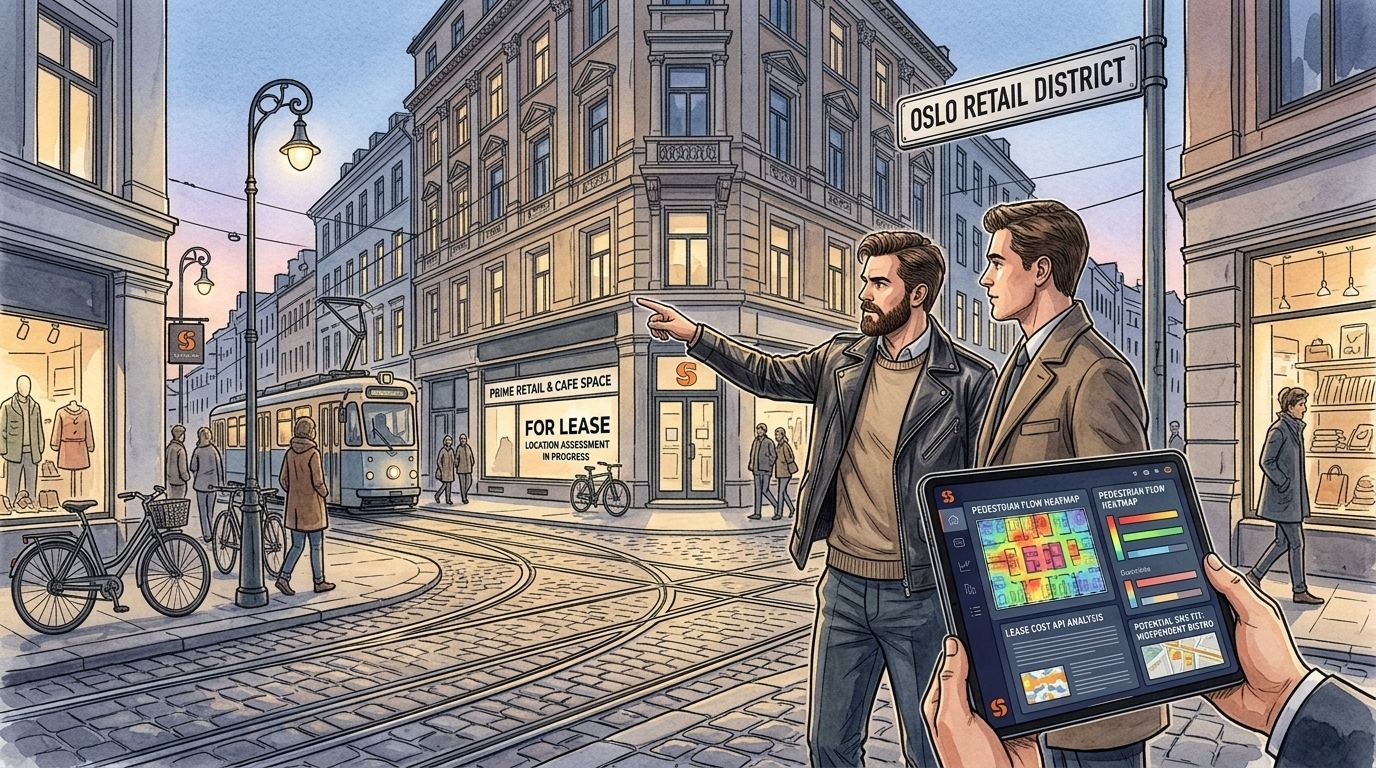

A good retail space is less about square metres and more about who walks past. Two spaces on the same street can be worth very different amounts, depending on which side of the street they are on, how visible the frontage is and who the neighbours are. In this guide, we explain how to assess the customer base and footfall before you commit to a lease for a shop, café or restaurant.
This article is part of our guide to retail and hospitality space.
Why location means something different for retail than for offices
When a company looks for office space, location is mainly about the employees. How easy is it to get there by public transport, how representative is the address, and how close are the clients you need to meet? The revenue is generated somewhere other than in the premises themselves. We have written about how different industries think about this in our article on offices by industry.
For shops and restaurants, the premises are the sales channel. Customers have to find you, see you and have a reason to walk in, and every day without enough visitors is lost revenue. So the question is not how easy it is for staff to get to work, but how many of the right people walk past, when they do it, and whether they notice you. That is also why rent for retail space is sometimes tied directly to sales through turnover rent, which is unusual for offices.
We recommend assessing a retail or restaurant space in five layers:
- Customer base: who lives, works and spends time in the area.
- Footfall: how many people pass the premises, when and at what pace.
- Visibility: frontage, windows, sightlines and signage.
- Neighbours: who draws people to the street, and who you compete with.
- Access: public transport, deliveries and what the premises are zoned and built for.
The rest of this article follows these layers.
Macro-location and micro-location
Macro-location is the area: the city, the district and the shopping street. It determines which customers are nearby. Micro-location is where the premises sit within that area: which block, which side of the street, whether it is on the corner or mid-block, how far it is to the nearest stop and whether it is at street level.
Many people start and stop with the macro-location. "We want to be on Grünerløkka" or "we want something in the city centre". But it is the micro-location that decides how much footfall the premises actually get, and that is where the big price differences are. Malling & Co's retail sector report from September 2026 points to micro-location as decisive for the rent a space can achieve, and uses which street corner a space sits on as an example. According to the broker consensus in the report, prime rent on Karl Johans gate is NOK 30,000 per m² per year. Malling's market overview from the same month puts normal rent in the area at NOK 8,000–15,000 per m², and its map of rent levels around Karl Johans gate ranges from NOK 2,500 to NOK 30,000 per m².
Use the macro-location to narrow your search, and spend most of your time on the micro-location once you are looking at a specific space.
Customer base: who is within reach?
The customer base is the people who could realistically become your customers. In a city, it helps to split them into four groups, because they behave differently.
Residents tend to shop in the evenings and at weekends, and they come back. They are the foundation for grocery stores, bakeries, neighbourhood cafés, hairdressers and gyms. Office workers are there on weekdays, especially in the morning and at lunch, and disappear during holidays. Visitors and tourists bring weekend, summer and holiday trade, but come back less often. Students bring plenty of traffic but often spend less per visit.
The balance between these groups changes. Oslo's Public Life Survey 2024 (Bylivsundersøkelsen), carried out by Sweco for the City of Oslo, shows that the number of people living in the city centre has nearly doubled since 2014. The centre is no longer just somewhere people visit. At the same time, Oslo had more overnight stays than any other county in Norway in 2025, with 6.9 million according to Statistics Norway (SSB). Visitors are therefore a customer group to plan for, especially in the city centre and along the waterfront.
Your concept should suit the group that dominates during your opening hours. A lunch restaurant in an office district can do very well five days a week and struggle in July. A neighbourhood café in a new residential area may see steadier traffic but a lower average spend.
The area your customers realistically come from is called the catchment area. For everyday needs like coffee and groceries, it is often walking distance. For specialist shops and restaurants with a clear concept, it can be the whole city. Back in 1963, the American researcher David Huff described a model that is still in use: the likelihood that a customer chooses your shop increases with how attractive your offer is and decreases with distance, measured against the alternatives nearby. You do not need to run the numbers, but you should be able to explain why a customer would come to you rather than to the competitor two blocks away.
You can find population figures and age profiles from Statistics Norway and in the City of Oslo's statistics bank, down to sub-district level. Telia also offers anonymised mobile data through Crowd Insights, which shows how, when and where people move around an area. For most smaller businesses, though, combining public statistics with your own observations is enough.
Footfall: count it yourself, and count it right
Footfall is the simplest measure of a retail location, and the most misunderstood. The Public Life Survey 2024 shows that the number of pedestrians in Oslo city centre on Saturdays has risen by 38 percent compared with the 2014 survey. That tells you the centre has become livelier, but very little about the door to your particular space. Footfall can be much weaker one block away, or on the other side of the street.
Footfall is measured in several ways. The city counts pedestrians manually in its public life surveys, some landlords have sensors that count passers-by, and mobile data gives a rougher picture over time. Always ask the landlord whether they have counts for the street or the building. If they do not, you will have to count yourself.
Stand on the same side of the street as the entrance and count everyone who passes for 15 minutes. Do it on an ordinary weekday in the morning, at lunchtime and late in the afternoon, and on a Saturday around midday. If you plan to run a restaurant, add a Friday evening. Note the weather and whether anything unusual is happening in the area, and convert the figures to an hourly rate if you want to compare spaces. Also count how many people stop, look in the windows or go into neighbouring shops. That says more about buying intent than passers-by alone.
Not everyone who walks past is a potential customer. People on their way to the train at eight o'clock walk fast and have one goal. They are gold for a coffee bar and almost worthless for a clothing store. Tourists strolling slowly stop more often, but buy different things from locals. So ask yourself how many of the people passing actually resemble your customers.
Solli plass is a good example of why volume is not everything. Malling's report shows that footfall there was weaker in 2024 than the year before, while the customers who did come spent more. Food and experiences accounted for 55 percent of turnover in the area in 2024. What counts is the spending power and purpose of the people who come, not just how many there are.
Visibility: frontage, windows and signage
A customer who cannot see you will not walk in. Visibility depends on the length of the frontage, how much window space you have, whether the premises are at street level and whether the entrance faces the street directly. Basement and upper-floor spaces can work for destination concepts, but get far less impulse traffic.
Test it during your viewing. Walk 50 metres in each direction and look back. Can you see the premises? Do trees, shelters, scaffolding or a protruding neighbouring facade hide the entrance? How does it look from the nearest stop or crossing, where many people stand still and look around? Come back after dark too. In winter, the lighting in your windows does the work for much of your opening hours.
Visibility is also about the street around you. The Public Life Survey 2024 concludes that what is on offer draws people to the city centre, and the same applies on a smaller scale. A street with many dark facades and empty windows gives people fewer reasons to walk there, even if the address is central.
Signage is part of visibility, and the rules are worth checking early. A sign of up to 3 m² mounted flat on the wall can be put up without a building application, provided it is the only sign on that facade. It must still comply with the rules, and Oslo has its own legally binding signage and advertising plan, designed to ensure good design and limit how dominant signs are in the streetscape. The city regards projecting signs over a pavement as a potential safety risk, so these require an application. Signs along municipal roads may also need permission from the Agency for Urban Environment (Bymiljøetaten). Check with the landlord what is allowed before you sign, not after.
Corner unit or mid-block?
Corner units are often among the most sought-after spaces on a shopping street. You get frontage on two streets, people coming from several directions see you, and there is often room for outdoor seating. The downsides are the price, and that a lot of window space leaves less wall space for products, shelving and storage. For a café or restaurant, that is rarely a problem. For a shop with a large range, it can be.
A mid-block unit is usually cheaper and offers more wall space, but depends more on people already walking past. With a narrow frontage and a neighbour that sticks out, it can become almost invisible. For destination concepts and well-known brands, it is often a good choice. For impulse retail, the frontage and footfall have to make up for not being on the corner.
Side of the street and position on the block
People rarely walk at random. Many choose the side of the street that leads to where they are going: the metro, the tram, the supermarket or the office. A space between a stop and a supermarket can therefore get plenty of footfall almost by itself, while a space on the opposite side may get far less. Do not take anything for granted. Watch where people actually walk during your viewing, and notice whether the sun pulls them to one side.
The neighbours matter more than you think
Your neighbours are part of the location. An anchor tenant, such as a supermarket, a well-known chain or a popular restaurant, draws people to the street who also walk past you. Neighbours that complement each other help each other: a café next to a bookshop, or a bakery next to a supermarket.
Restaurants attract restaurants. Malling's sector report shows that 44 percent of the units in the central Oslo shopping streets Malling tracks are food and experiences. When several restaurants are clustered together, the street becomes a destination, and each one gets visits from customers who were originally heading somewhere else. The same applies to shops selling goods customers like to compare, such as clothing and interiors. Competing for exactly the same customer and the same purpose, on the other hand, rarely pays off. Two identical coffee bars side by side tend to split the customers rather than create more.
Many landlords actively manage their tenant mix, and some do not want certain concepts in a unit or a building. Ask which types of tenants the landlord is looking for, which they have turned down, and which leases in neighbouring units expire over the next few years. Count the empty units on the street too. Lots of empty windows are a warning that footfall does not support the rent level.
If the anchor tenant moves out, footfall can drop quickly. We have explained how such situations can be handled in the lease in our article on turnover rent.
Destination or impulse?
The most important question before you assess a location is why customers come to you. Impulse purchases are the ones people did not plan: coffee, takeaway, a kiosk, a quick lunch and affordable fashion. These concepts live off passing traffic and need to be where people already walk, with good visibility.
Destination concepts are places customers seek out on purpose: specialist shops, restaurants that take bookings, hairdressers and clinics with appointments. They can be on a side street, pay lower rent and spend the difference on marketing.
Most concepts are a mix, and it is easy to overestimate how much of your revenue comes from people who decided in advance. Be honest about how many of your customers come because they happen to walk past, and choose your location accordingly.
Access: public transport, deliveries and cars
Being close to the metro, tram and buses brings footfall throughout the day. The Public Life Survey 2024 shows that more people walk and cycle in the city centre than in 2014, while car and public transport use has fallen. If you sell large items that customers have to take home, think through how the goods will get to them, for example through delivery.
Deliveries are often overlooked. Pedestrian streets and streets with restricted traffic often have fixed delivery windows. Check where the goods entrance is, whether suppliers can park nearby and whether the delivery windows suit your operations. For a restaurant with daily deliveries of fresh produce, this can decide whether day-to-day operations work.
Special considerations for restaurants and cafés
A restaurant space has to suit both your customers and your kitchen. The first thing to check is whether the premises are zoned and approved for food service. If the space has been used as a shop, you will need to apply for a change of use, and approval is not guaranteed.
A kitchen that fries or grills needs extraction, usually ducted above the roof, and a grease trap on the drainage. This is decided by the building, not your concept, and in older buildings it can be expensive or impossible to arrange. Ask what is already in place, and who pays for what is missing.
Homes on the floors above affect what is possible with music, opening hours and cooking smells, and can lead to complaints that follow you throughout the lease.
Outdoor seating can make a real difference in season. Pavements and squares are usually municipal land, so you will need an agreement with the city. How much space you get depends on things like the width of the pavement and how much room pedestrians need to pass. Look at the physical space outside before you include outdoor seating in your budget.
Finally, you need a licence to serve food, and a licence to serve alcohol if you plan to. The general manager must have passed the food service management test (etablererprøven). When the city assesses an application to serve alcohol, the Alcohol Act allows it to consider the location of the premises, among other things, and to set conditions on matters such as serving hours.
What location means for your rent
Rent for retail and restaurant space can vary considerably within a small area. The prime rent of NOK 30,000 per m² applies to the best locations on Karl Johans gate, not the city centre as a whole.
Imagine two spaces of 100 m². One is at a prime address at NOK 30,000 per m² per year, the other at NOK 8,000 per m², the bottom of Malling's estimate for normal rent in the same area. The difference in rent is NOK 2.2 million a year, before service charges. With a gross margin of 50 percent, the expensive space has to generate NOK 4.4 million more in sales every year just to break even against the cheaper one. The figures are an example, not a recommendation, but the calculation is worth doing for every space you consider.
Large chains may choose a prime address as much for visibility and the brand as for the sales in the store itself. As an independent operator, the numbers have to add up in day-to-day operations. If you are unsure whether a location will deliver the sales you need, rent that partly follows turnover can share the risk between you and the landlord. Read more in our article on turnover rent.
Three areas, three types of customer base
Oslo city centre
The city centre has a broad customer base: people from across the region, office workers, tourists and a growing number of residents. The Public Life Survey 2024 also shows that the area where people actually spend time has grown, and now includes Torggata, Christiania torv and the waterfront around the Opera House and Sørenga, among others. Karl Johans gate has a prime rent of NOK 30,000 per m², according to Malling, and suits flagship stores and impulse retail. Outside the best blocks, rents are lower, and destination restaurants and specialist shops may find the numbers work better there. See available retail and hospitality space in Oslo city centre.
Vika
Vika is an office-heavy business district, and that shows in the footfall, with busy mornings and lunchtimes on weekdays. Along the waterfront towards Aker Brygge and Tjuvholmen, the seafront draws people in the evenings, at weekends and in summer. The Public Life Survey 2024 shows that seven of the ten most-used public spaces in the city centre are along the waterfront, and that the most active part of the centre now also includes Tjuvholmen. Prices are high, and the area suits business lunches, takeaway, delicatessens, specialist shops and restaurants and bars that stay open in the evening. Expect the July holidays and Christmas to bring quieter weeks in the office areas. See available retail and hospitality space in Vika.
Hasle and Løren
Hasle and Løren are part of Hovinbyen, Oslo's largest urban development area. According to the City of Oslo, around 10,000 homes had been built in Hovinbyen by 2025, including at Løren and parts of Hasle. The customer base is a growing population in new residential blocks, with metro stations and quick access to Ring 3. This is the place for neighbourhood concepts that rely on repeat customers: cafés, bakeries, grocery stores, gyms, health services and offers for families with children. Rents are lower than in the city centre. Bear in mind that the area will be under development for many years to come, and construction work can close walkways and shift footfall for periods of time. See available retail and hospitality space at Hasle and Løren.
Checklist before you sign
- Visit the space at least three times: a weekday lunchtime, an afternoon or evening and a Saturday.
- Count passers-by for 15 minutes each time, and note how many stop or look in.
- Check whether the space is on the side of the street, and in the direction, that people actually walk.
- Walk 50 metres in each direction and check whether the frontage and entrance are visible.
- Map the neighbours: who draws people in, and who competes with you for the same customer?
- Count the empty units on the street.
- Talk to neighbouring shops about how traffic varies through the year.
- Ask the landlord for footfall counts, when leases in neighbouring units expire and plans for the building.
- Check planned building projects and roadworks in the area with the Planning and Building Agency (Plan- og bygningsetaten).
- Find out what signage you are allowed to put up.
- For restaurants and cafés: check zoning, extraction, grease trap, outdoor seating options and who lives upstairs.
Frequently asked questions
What makes a good location for a shop?
A good location is where your customers already spend time, where they can see you and where the neighbours draw people to the street. It is not necessarily the most expensive address. For impulse retail, footfall and visibility are crucial, while destination shops can do well on side streets with lower rent.
What is the difference between macro-location and micro-location?
Macro-location is the area the premises are in, such as the district or the shopping street. Micro-location is the exact position: the block, the side of the street, corner or mid-block, and the distance to stops and anchor tenants. For retail and restaurants, it is often the micro-location that decides both footfall and rent.
How do I measure footfall outside a space?
First, ask the landlord whether they have counts. Then count yourself: stand by the entrance and count passers-by for 15 minutes at different times, on both weekdays and weekends. Note the weather, and also count how many stop or look in, because that says more about buying intent than passers-by alone.
Is a corner unit worth the higher rent?
It depends on your concept. A corner gives you visibility from two streets and often room for outdoor seating, which is valuable for cafés, restaurants and impulse retail. For shops with a large range, the large window area can leave too little wall space. Work out whether the extra visibility brings in more revenue than it costs.
What should I look for in a space for a café or restaurant?
As well as footfall and visibility, the premises must be approved for food service and allow for extraction and a grease trap. Also check who lives on the floors above, whether there is room for outdoor seating and how deliveries will work. If any of this is missing, the space can be expensive or impossible to operate.
Do I need permission to put up a sign in Oslo?
A sign of up to 3 m² mounted flat on the wall can be put up without a building application if it is the only sign on that facade. It must still comply with the city's signage and advertising plan. Projecting signs over a pavement require an application, and signs along municipal roads may also need permission from the Agency for Urban Environment. Check with the landlord before you sign.
Is it worth paying more for a prime location?
Only if the extra sales cover the extra rent with a good margin. Work out how much more you need to sell to cover the difference, and be conservative with your estimates. If you are unsure, rent that partly follows turnover can share the risk between you and the landlord.
How we can help
At Spacefinder, you can find available retail and hospitality space from Oslo's leading property owners in one place, and our advisers help you assess the location before you go to a viewing. The service is completely free for tenants. Start with our needs analysis, or send an off-market request if you want to reach landlords who are not actively advertising their space.