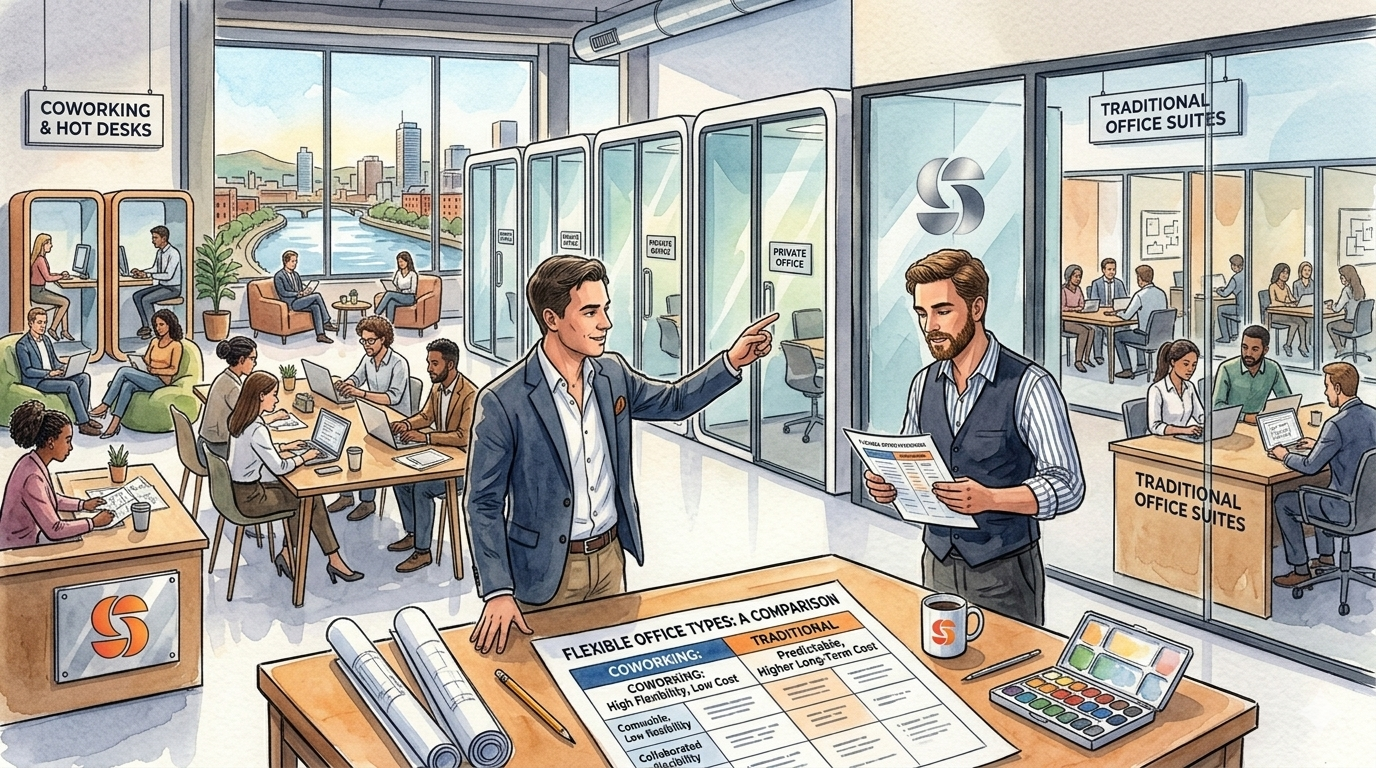

When a company starts looking for new office space, the question of lease type is often settled before the search begins. Some go straight to shared office concepts because it seems easiest, others straight to traditional premises because that is how they have always done it. The choice deserves more attention than that. The type of lease determines how long you commit, how much you share with others and how your costs are structured. Here we go through the three options and what actually separates them.
Three options, two types of agreement
The most important distinction is not between serviced offices and coworking, but between those two on one side and a traditional office on the other. In a serviced office or coworking space, you rent workstations from an operator who runs the premises, whether that operator is a separate company or the landlord itself. You pay a fixed price per workstation per month, and most things are included. With a traditional office, you lease your own premises directly from the landlord, pay rent per square metre per year and handle fit-out and operations yourself.
Serviced offices: a private office with services around it
A serviced office gives you a private, lockable office in a building where other companies rent similar rooms. Reception, meeting rooms, internet, cleaning and coffee are normally included in the rent, and the offices are furnished and ready to move into. The option suits companies that want a professional setting without spending time on operations, and that want to be able to receive clients from day one.
Coworking: the community comes with it
Coworking is often associated with open-plan spaces and freelancers with laptops, but the picture has changed. Most coworking providers today mainly rent out private offices with access to shared areas, and in practice the terms coworking and serviced office are used interchangeably. What still sets a coworking concept apart is the emphasis on community: events, social zones and an environment where companies get to know each other. Most also offer fixed or flexible desks in open-plan areas, which is the most affordable way in. To learn more about where the concept came from and how the different desk types differ, read our guide to what coworking is.
Traditional offices: your own premises and full control
With a traditional office, you lease your own space directly from the landlord. You decide the layout, interior, IT and branding yourselves, and the premises become an expression of the company. In return, you have to provide furniture, network and fit-out yourselves, and service charges come on top of the rent. These can cover operations, caretaking, electricity, cleaning and property tax. The lease term usually runs over several years, and the rent is normally adjusted annually in line with the consumer price index. The standard Norwegian lease agreement for commercial premises, for example, adjusts the rent every 1 January in line with changes in Statistics Norway’s consumer price index. That gives predictability, but also a commitment that is harder to get out of if the company grows faster or slower than planned.
Flexibility: how long are you committing?
For most companies, flexibility is the main reason to choose a serviced office or coworking. Most providers offer rolling agreements with a notice period of one to three months, and you can often add or reduce workstations within the same building. Terms still vary. Some operators combine rolling notice with a longer agreement period, so read the agreement carefully before you sign.
A traditional lease commits you for the whole lease term. If you end up with too much space along the way, subletting is often the most realistic way out. If you plan to renew or move, it pays to start early, ideally 12 to 18 months before the lease expires.
Privacy and focus
How much privacy you need depends largely on your industry. Lawyers have a strict duty of confidentiality towards their clients under section 32 of the Norwegian Lawyers Act, and section 4-2 of the Accountants Act and section 10-1 of the Auditors Act require accounting and audit firms to prevent unauthorised persons from gaining access to information about their clients. For these firms, soundproofing, separate meeting rooms and control over who moves through the premises matter more than in most other industries, and a traditional office gives the most control. A closed office in a serviced office or coworking space can work well. If so, check the soundproofing towards neighbouring rooms during the viewing, and how easy it is to get a meeting room when you need one. An open desk in a coworking space offers the least privacy and suits work that is not sensitive.
What do the three options cost?
Prices are quoted in different ways, which makes comparison difficult. Serviced offices and coworking are priced per workstation per month, while traditional office premises are priced per square metre per year, with service charges on top.
For a private office in a shared office concept in Oslo, prices range from around NOK 5,000 to NOK 13,000 per workstation per month. Based on agreements Spacefinder has been involved in, we estimate an average of around NOK 7,500 for central and presentable premises. A desk in an open-plan area typically starts at NOK 2,000 to 3,000 per month. You will find prices broken down by area in our overview of what coworking costs in Oslo.
For traditional premises, the price per square metre ranges from under NOK 2,000 per year on the outskirts to over NOK 6,000 in the most attractive central areas, as shown in our overview of the total cost of office space in Oslo. A common rule of thumb is 15 to 25 square metres per employee, as we explain in our guide to how many square metres of office space you need per employee. At a rent of NOK 4,000 per square metre per year, that gives a cost of NOK 5,000 to 8,300 per employee per month, before service charges, furniture and operations.
The calculation shows why coworking is not necessarily more expensive than your own office. In a shared office concept, operations, cleaning, internet and shared areas are included, and we estimate this corresponds to around 40 percent on top of the base rent in an ordinary office building. Compare the total cost, not the price per square metre or per workstation.
Who does each option suit?
An open desk in a coworking space suits freelancers, founders and small teams who want people around them and a low threshold to get started. A private office in a serviced office or coworking space suits small and medium-sized companies that are growing or unsure how many people they will be. It also suits established companies that need a project office or a satellite office in a new city. A traditional office suits companies that know how many workstations they need over the next few years, that want to put their own stamp on the premises, or that have requirements for privacy and representation that a shared building cannot meet.
Your industry also pulls in a particular direction. In our overview of office space by industry, we look at what law firms, accounting firms, consultancies, creative agencies and tech companies should look for. The law firm tends to sit at one end of the scale, with long leases and high demands for representation and confidentiality. The tech startup sits at the other, where short agreements, room to grow and the right community matter more than the price per square metre. Read more in our guide to offices for tech startups in Oslo.
Many companies move between the options over time. The tech company Installer.com was based in a shared office in Vika that Spacefinder had helped them find. As the company grew to 13 employees, they wanted something more of their own and ended up in a traditional office at Nedre Slottsgate 13-15 with Promenaden in Kvadraturen.
The lines between the options are blurring
The boundaries between the three options are less sharp than before. Coworking providers have moved towards private offices, and more and more landlords in Oslo are building shared office concepts in their own buildings instead of leasing to an operator. We have written more about this in when the landlord becomes its own operator. For tenants, this means more options in between, such as a private office with access to shared meeting rooms and social zones, or premises with an option for expansion space in the same building.
How to get started
Start with your needs, not the listings. Find out how many people are actually in the office at the same time, how much privacy the work requires, how often you have visitors and how certain you are about headcount over the next couple of years. The answers usually point clearly towards one of the options. Our needs analysis takes two minutes and gives you a good starting point. After that, it is worth viewing several alternatives before you decide.
How we can help
At Spacefinder, we help tenants find and compare all three types of premises, and we follow the process from the first needs analysis to a signed lease. The service is completely free for tenants. Get in touch for a no-obligation conversation.