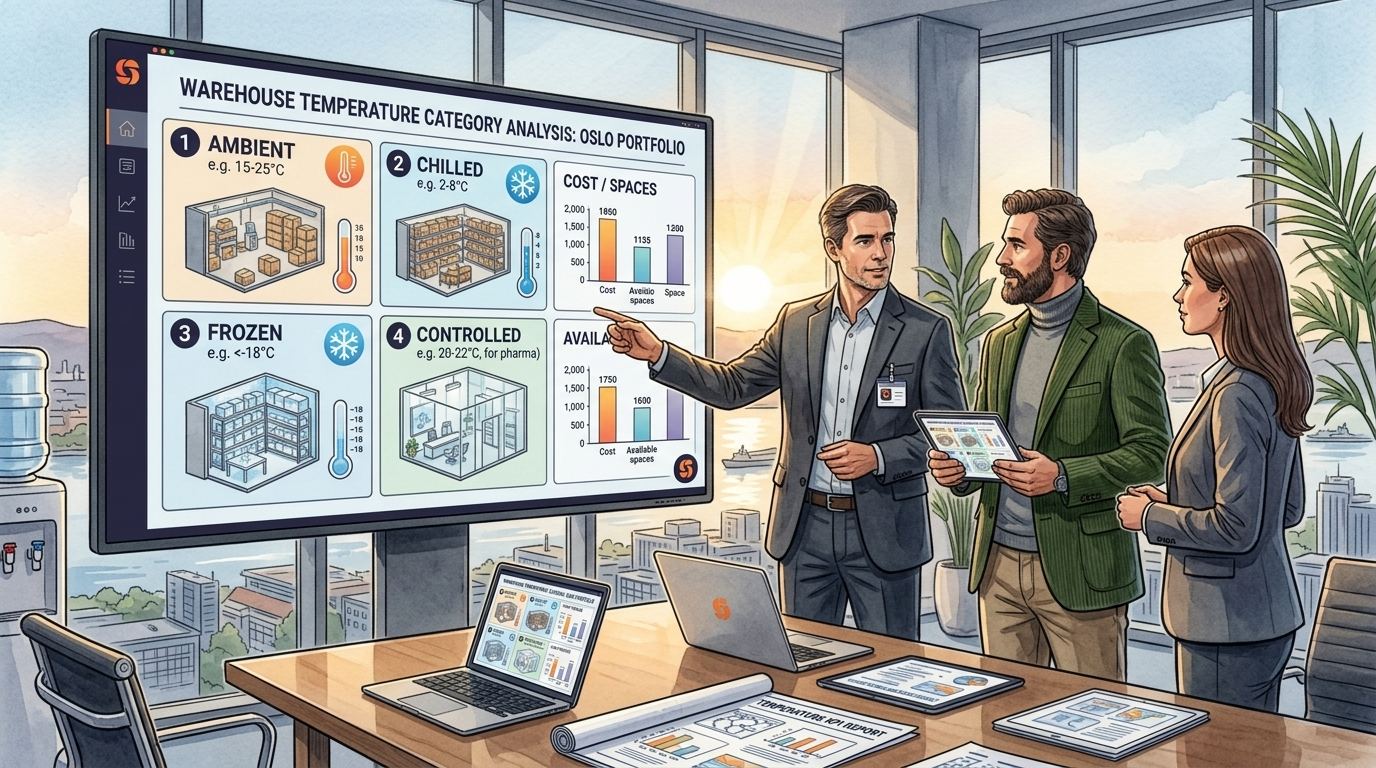

Cold storage, heated storage, temperature-controlled storage and freezer storage are often used interchangeably, but are four different things for a business looking to lease space. Here we go through what actually sets them apart, what the regulations require, and how you find the right solution for your goods. Not sure which category your business needs? Get in touch with us, and we will help you find the right solution.
1. Cold storage, heated storage, temperature-controlled storage and freezer storage explained
The four terms describe a spectrum from unheated to strictly controlled, and the difference in practice comes down to how much control there is over the temperature.
Cold storage (kaldtlager) is unheated storage where the temperature simply follows the outdoor temperature. Some cold storage is frost-protected, so the temperature doesn't drop below a certain minimum even on cold days, but there is still no active heating. This suits goods that tolerate cold and temperature swings, such as building materials, tyres or archived stock.
Heated storage (varmtlager) is heated and normally kept on the plus side year-round, often in the range of 10 to 18 degrees. This is the classic solution for goods that can't tolerate frost, and for most ordinary warehouse and combination premises, heated storage is the standard.
Temperature-controlled storage (temperert lager), also called climate storage, is actively temperature-regulated within a defined range, not just heated. Within this category there are several subtypes with different requirements: chilled storage for perishable goods, normally down to 0 to 4 degrees, so-called "sval" storage for goods like potatoes and vegetables, typically 8 to 12 degrees, and controlled room temperature of 15 to 25 degrees for pharmaceuticals and electronics. The common denominator is documented, monitored temperature, not just a general ceiling or floor reading.
Freezer storage (fryselager) holds sub-zero temperatures, and Norwegian regulations set the limit at −18 degrees or colder for deep-frozen goods.
Two related terms are worth knowing. "Termo" is the Norwegian logistics industry's umbrella term for temperature-controlled transport and storage, and an approved refrigerated truck can typically be set anywhere between +15 and −18 degrees. Cold chain describes keeping the temperature unbroken from production to consumer, and is often the actual requirement a client sets, regardless of which storage category you end up choosing.
What the four categories actually mean in practice depends on which regulations apply to the goods you plan to store. We look at that next.
2. What does Norwegian regulation require?
If you're storing food, pharmaceuticals or chemicals, temperature alone isn't enough. Documentation and approval are often just as decisive.
For food products, Mattilsynet, the Norwegian Food Safety Authority, sets concrete requirements. Deep-frozen goods must be kept at −18 degrees or colder, and perishable goods must be stored at the temperature stated on the packaging, or at 4 degrees or colder if no temperature is stated. Any freestanding cold or freezer store used for animal-origin food must be approved by Mattilsynet, with a few exceptions for eggs, honey and meat from marine mammals. Always check whether an existing cold or freezer store actually holds this approval before you add it to your needs assessment, it can save you a long detour later.
For pharmaceuticals, separate guidelines from Legemiddelverket (the Norwegian Medicines Agency) apply. Standard storage temperature is 15 to 25 degrees, while refrigerated products such as insulin and vaccines must be kept at 2 to 8 degrees. The requirement is continuous temperature monitoring with calibrated loggers, and that the facility has been temperature-mapped so the warmest and coldest points are actually known.
On the building side, TEK17 (Norway's building code) sets requirements for insulation and energy use, and for freezer storage the floor is a typical pitfall: without underfloor heating, frost can penetrate the ground and cause frost heave, which can damage the building structure over time. Newer freezer facilities solve this with heating cables in the floor, specifically to counteract this.
Worth keeping in mind is also that refrigerants are changing. An EU regulation setting new limits for refrigerants with a high global warming potential applies from 2025, which means newer freezer facilities are increasingly built with natural refrigerants such as ammonia or CO₂. This is most relevant if you're considering a new build or a major refurbishment, but it's a good sign that a facility has been upgraded if the landlord can point to this.
3. What can you expect to pay, and what drives the cost?
Cold storage and heated storage are priced largely as ordinary warehouse space, within the usual range for warehouse premises in the Oslo region. Temperature-controlled storage and freezer storage are a different cost class.
Insulation, refrigeration equipment and monitoring systems mean that cold and freezer storage is a significantly more expensive category to build and operate than ordinary heated storage. Norwegian brokers don't work with a fixed, published price premium for cold and freezer storage the way they do for ordinary warehouse space, it's normally priced project by project, after a concrete assessment of the building and the plant.
Operating cost is the part many people underestimate. The refrigeration plant is often the single largest item in the operating budget for a cold or freezer store, and this comes on top of the rent. It should therefore be factored in when comparing a cheaper facility against a more expensive alternative with newer, more energy-efficient equipment.
The market for cold and freezer storage in Norway is also concentrated among a few specialised operators rather than spread across all logistics buildings. ASKO's central chilled goods facility in Vestby, Oslo Fryselager under construction near Gardermoen, and operators such as Frigoscandia and Cooling Partner, illustrate that cold and freezer capacity tends to gather in a handful of specialised facilities rather than being spread across the ordinary warehouse market. Demand is driven in particular by grocery e-commerce, seafood exports and the pharmaceutical cold chain, which means available cold and freezer storage can be harder to find than an ordinary heated warehouse in the same area.
4. Which solution fits your business?
The simplest starting point is to look at what the goods actually require, not which category is easiest to find advertised.
If it's about building materials, vehicles or archived stock that tolerate cold and temperature swings, cold storage is a perfectly adequate, cheaper solution. There's rarely a reason to pay for a heated or cooled facility if the goods don't require it.
If the goods are frost-sensitive but don't need cooling, such as electronics, paint or ordinary resale goods, heated storage is the right starting point. This is also the standard for most combination premises with office and warehouse space under one roof.
If the goods require documented temperature within a range, such as pharmaceuticals, chilled goods or wine, temperature-controlled storage is the right category, but you need to check which temperature band the facility can actually deliver, and whether the plant has the monitoring your goods require.
If the goods are deep-frozen, such as food, seafood or ice cream, you need freezer storage, and for animal-origin food that means in practice that the facility also needs Mattilsynet's approval.
Sources: Norsk Fryseriforening's storage terms (via Cooling Partner), Mattilsynet, Lovdata (Regulation on deep-frozen foodstuffs), Legemiddelverket, Standard Norge, EU regulation on fluorinated greenhouse gases (2024/573), UNION, Malling & Co and DNB Næringsmegling, as well as Spacefinder's own market observations.